
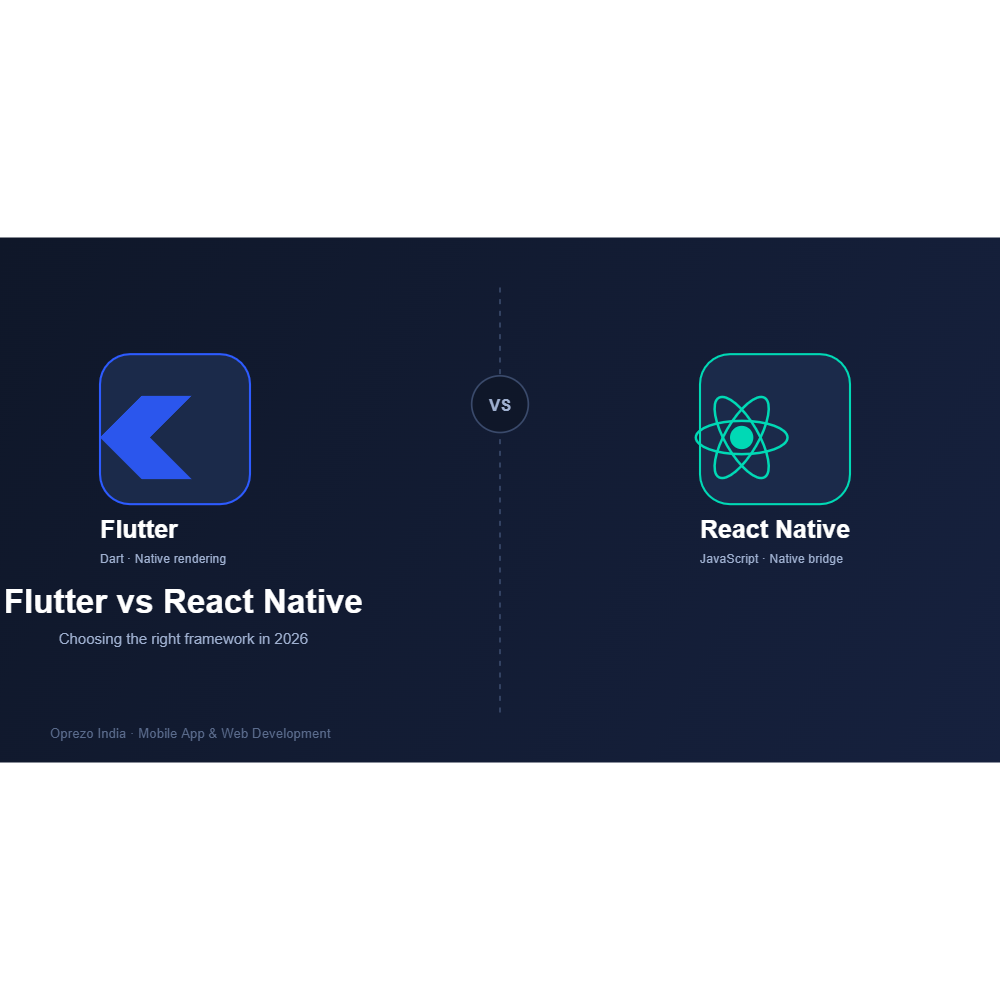
Cross-platform development has become the default choice for most startups and growing businesses — and Flutter and React Native remain the two biggest names in that space. Both let you build for Android and iOS from a single codebase, but they're built differently and suit different kinds of projects. Here's a practical comparison to help you decide.
Flutter, built by Google, uses the Dart language and renders its own UI components directly, which gives it tighter control over visuals and animations. React Native, built by Meta, uses JavaScript/TypeScript and bridges to native components, which makes it a natural fit for teams that already have web development experience in React.
Flutter tends to have a slight edge in rendering-heavy apps because it doesn't rely on a JavaScript bridge to communicate with native UI elements. React Native has closed much of this gap with its newer architecture, and for most standard business apps — e-commerce, booking, content, services — the performance difference is rarely something end users notice.
React Native benefits from the massive existing pool of JavaScript developers, which can make hiring and scaling a team easier, especially if your in-house team already knows React for web. Flutter's Dart talent pool is smaller but growing fast, and many React/Angular developers pick up Dart quickly because of similar syntax patterns.
Flutter apps tend to look and behave identically across Android and iOS because Flutter draws its own widgets rather than relying on native ones. This is a big plus for brands that want pixel-perfect, consistent design. React Native apps lean more on native components, which can mean slightly different look-and-feel between platforms unless you customize carefully.
React Native has a longer track record and a wider third-party package ecosystem, given its earlier release and large JavaScript community. Flutter's package ecosystem (pub.dev) has matured significantly and now covers most common use cases — payments, maps, push notifications, AI integrations — but for very niche native functionality, React Native sometimes has more ready-made options.
You want pixel-perfect, brand-consistent UI across platforms
Your team already has strong React/JavaScript expertise
Neither framework is objectively "better" — the right choice depends on your team's existing skills, your design ambitions, and your long-term roadmap. For most startup MVPs and mid-sized business apps, both frameworks comfortably deliver production-quality results at a fraction of native development cost and timeline.
Not sure which stack fits your project? Oprezo India's developers can review your requirements and recommend the right framework before you commit.
Flutter vs React Native 2026: Which Is Better for You?
 Mobile App Development Cost in India 2026 | Pricing Guide
 App Development Under 1 Lakh India 2026 | Oprezo India
 What Is Flutter App Development? Complete Guide 2026 | Oprezo India
 Mobile App Development Cost India 2026 | Oprezo India